
You’re two hours out of Southampton, phone’s in your pocket, you haven’t touched it — and a text lands: “You’re now roaming. Charges may apply.” Roaming. In the middle of the English Channel. No country in sight, let alone a border you’ve crossed. That’s roaming charges at sea in a nutshell: no borders, no logic you’d expect, just a bill quietly ticking upward.
A colleague of mine found this out the expensive way — on her work phone, of all things. One transatlantic crossing, one forgotten “turn off data roaming” reminder, and finance ended up querying a phone bill that had quietly gone up by a few hundred pounds. She still gets ribbed about it in the office. It’s a genuinely easy thing to miss, and it happens to people constantly — this isn’t a rare fluke.
This post contains affiliate links for GigSky and Maya.
Table of Contents
What’s Actually Happening: The Ship Has Its Own Phone Network
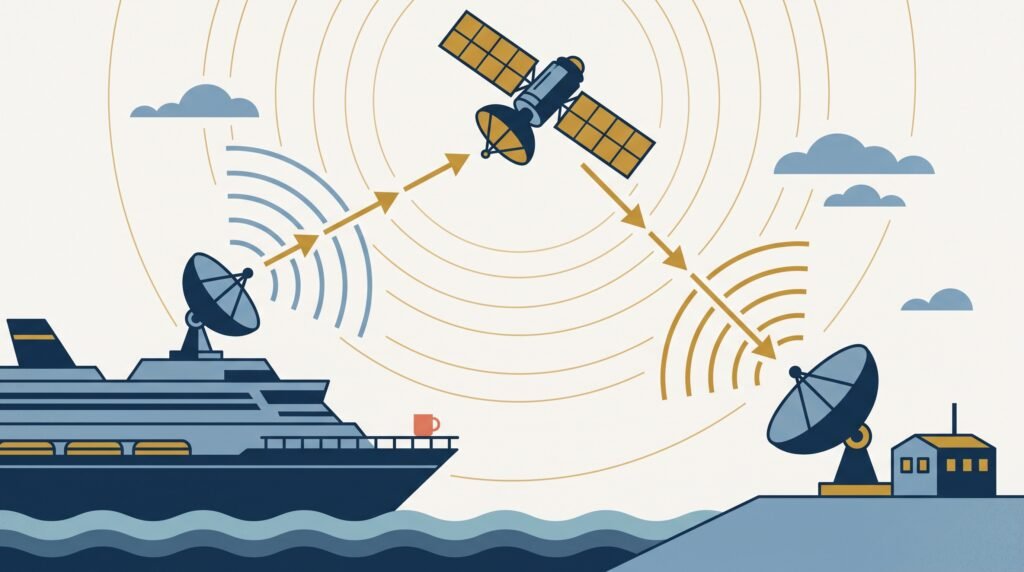
Once you’re out of range of ordinary land-based masts, your phone doesn’t just lose signal — it finds a new one. Cruise ships carry their own miniature cellular network built into the superstructure, beaming out standard 4G/LTE inside cabins and public decks. Your phone can’t tell the difference between that and a normal network, so it locks on automatically, no prompt, no permission asked. You’ll usually see it show up under a name like “Cellular at Sea,” “Tampnet,” or “Wireless Maritime Services” — sometimes just a numerical code, 901, which is the international designation for shared maritime networks.
Why It’s So Eye-Wateringly Expensive
Here’s the bit that catches people out: that onboard network has to get your data back to shore somehow, and the only route is satellite — there’s no undersea cable running alongside the ship. Satellite bandwidth is scarce and expensive, and because it’s all happening in international waters, none of the normal price-cap protections apply. The result is data priced by the megabyte, not the gigabyte — commonly somewhere around £7–10 per MB.
The dangerous part isn’t deliberately scrolling Instagram. It’s everything your phone does when you’re not looking — mail syncing in the background, photos quietly backing up, apps refreshing themselves. A few seconds of that can chew through several megabytes before you’ve even unlocked your screen.
The UK Rules That Don’t Actually Save You Here
Ofcom brought in decent protections in October 2024 — mobile providers now have to text you the moment you start roaming, and there’s a default £45 spending cap to stop things running away. Reasonable, on land. At sea, the maths doesn’t hold up: maritime data is so expensive that you can blow straight past £45 in the literal seconds it takes that warning text to arrive. Worse, providers like giffgaff and Sky Mobile explicitly exclude maritime roaming from their allowances altogether — so any bundle or cap you think you’re covered by simply doesn’t apply once you’re on 901.
How to Actually Avoid It
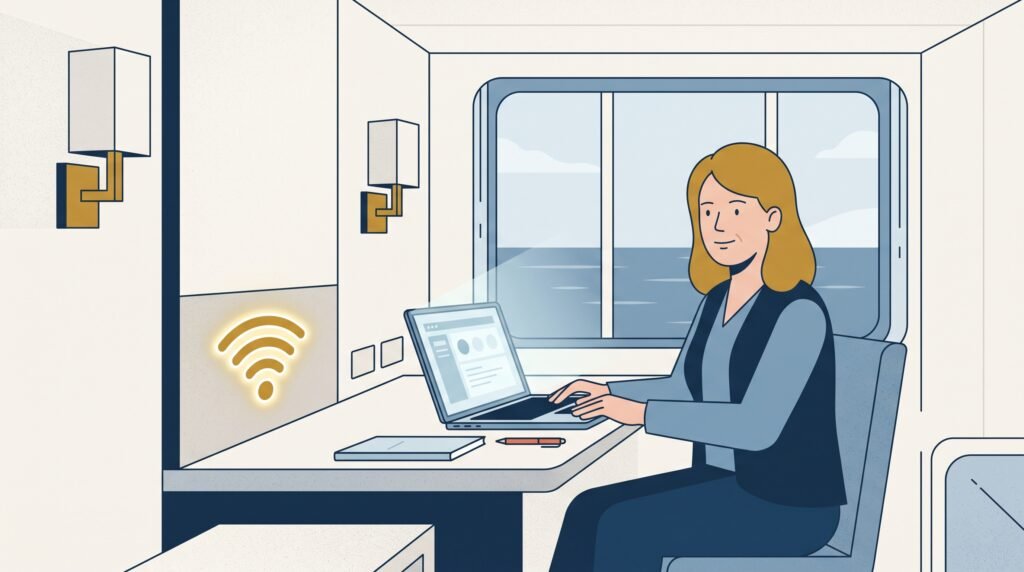
The fix: switch to airplane mode before you lose your home network’s signal — ideally as the ship pulls away from port, not after. Once you’re in airplane mode, you can turn WiFi back on separately without ever re-enabling the cellular radio that gets you into trouble in the first place.
From there, your options are the ship’s WiFi package if you’ve bought one, or an eSIM you’ve set up in advance — we use GigSky and Maya, and cover picking between them properly elsewhere on the site, see How Much Data Do You Actually Need? — along with how the whole mechanism actually works, covered in How Does eSIM Work at Sea?, if you want the fuller picture.
Last updated August 2026. This post contains affiliate links for GigSky and Maya — I get a small commission if you buy through them, at no extra cost to you. More on how that works →
Still deciding which eSIM?
Answer a few questions, get a personalised recommendation in under a minute.